
Ulster Solemn League and Covenant
On this day 28th of September 1912
Ulster’s Solemn League and Covenant was signed on and before by almost 500,000 men and women, in one of the biggest mobilisations of the Protestant faith and the Unionist people in the British Isles. To this day the political and social implications can still be seen throughout Northern Ireland and Scotland, and the Covenant remains as a key foundation for organised resistance to Home Rule.
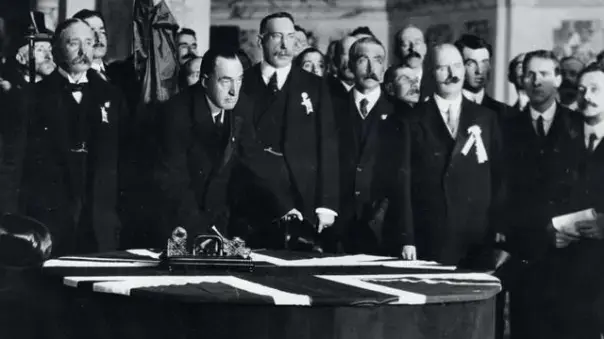
The Orange Order, Scotland, and the Ulster Covenant.
The Orange Order in Northern Ireland were hugely influential in the signing of the Ulster Covenant. Orange processions, banners and bands gave the Covenant campaign a sense of spectacle reinforcing the Protestant identity which resulted in close to 500,000 men and women signing the Covenant.
The powerful sense of support and resilience was echoed across the water in Scotland. Orange men across Scotland supported their brethren with the Covenant and the wider resistance to Home Rule. Scottish Lodges across the country circulated pamphlets and gave speeches in Orange Halls, created Unionist sentiment, and helped spread the fighting spirit amongst the Orangemen in the country.
Furthermore, significant pockets of Ulster Protestant settlements were to be found all over Scotland including regions such as the Lothians, Dunbartonshire, and Stirlingshire. However, due to the industrial geographical landscape the vast majority of Ulster Protestants were in the economic hubs of Glasgow and Lanarkshire at the time. This was significant as small towns all over Scotland played their part in helping to shape the future political landscape of both Ulster and Scotland.
In Motherwell, the Ulster identity was easy to see. Killyman True Blues L.O.L. 712 were formed by men who had moved to Motherwell from Killyman in County Tyrone. A large section of the Lodge worked at Baird’s & Sons and were provided by the company with bunting and other accessories yearly to celebrate the 12th of July. This powerful sense of Orangeism in the area helped result in 500 signatures coming from the town of Motherwell alone.
In Bellshill, there were 300 signatures for the Ulster Covenant. One memorable addition to the signing in the area was Donaghadee-born entrepreneur, Francis Dobson Dorrian. The entrepreneur made his fortune within Lanarkshire Coal industry and was a member of his local Lodge in Bellshill before eventually rising to the rank of Grand Master of Scotland.
In Coatbridge, home to a healthy Protestant community, two months before the launch of the Ulster Covenant, the town hosted an Anti-Home Rule demonstration with an incredible 40,000 people assembling to show their distaste to the Government’s Irish Policy. Coatbridge was also to be the scene of the single largest Scottish signing outside of greater Glasgow with 987 men and women signing the Ulster Covenant.
In Glasgow, which was known as the second city of Orangeism, Scotland’s largest city was a focal point for signings of the covenant. Although the support was always expected from the Orange and Protestant people of Glasgow it was much bigger than what was initially predicted. The Unionist Association of Ireland initially only had one venue available in Glasgow for signing. However, the demand to sign surged and the Headquarters of the Grand Orange Lodge of Scotland soon become available as well as various Orange Halls in Partick and Camlachie as signing centres. Glasgow delivered in its loyalty to the union and the Orange Order played a pivotal role in the 7,265 signatures that were delivered from the city. This amounted to just over half the total number of Covenant and Declaration signatures recorded in the whole of Scotland.
In West Lothian, mining villages including Broxburn, Uphall, Boness and Armadale showed dedicated support for the signing of the Covenant. The West Lothian Courier reported that within the town of Broxburn “the Unionist cause was flourishing, with a raft of institutions, including no less than five Orange Lodges”. One of these Lodges, the Heart of Oak L.O.L. 44 was founded by an Ulsterman. This powerful sense of Orangeism in the town resulted in 243 people from Broxburn signing the pledge in the towns Alexandria Hall.
In Ayr and Troon, the Protestant community delivered as well supporting the Anti-Home Rule initiative with 90 signatures coming from Troon and 188 from Ayr. In total 1,824 names came from Ayrshire towns.
The enduring legacy of the Orange Order in Scotland and our historic defiance remains embodied by the Ulster Covenant of 1912. We find more than just a chapter of protest and unionist identity. We find people that are fiercely committed to their beliefs, traditions, and a way of life. This was the case 100 years ago and the sense of Unionism and belief has only strengthened over time within the Loyal Orange Institution of Scotland.


Comments